By Johanna Mattila
In this article, I discuss otherness in the artistic process. My perspective is based on the principles of inclusion and accessibility.
Accessibility can be understood from two perspectives. The first is physical accessibility, which includes both how to get to a place and the accessibility of the place itself for people with disabilities. The second is accessibility from the perspective of inclusion. I will now look at both of these perspectives of accessibility in relation to the places we visited.
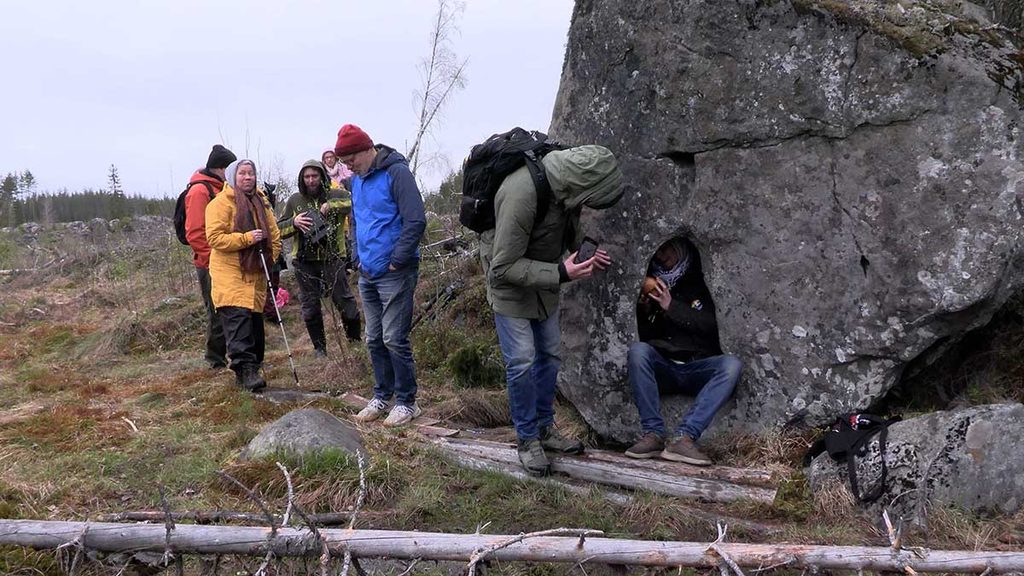
The first stage to Karhunkallio involved a car journey and then walking over varying and partly swampy terrain. I am used to walking in the forest despite my blindness, so the journey to Karhunkallio was not completely impossible for me. However, I could not walk right up to the recording location, as the terrain was downright dangerous for a blind person. Fortunately, I was able to follow what was happening there from a distance, although some of it was only guesswork. I would have certainly enjoyed myself more if the weather had been warmer and the rain had left us alone.
From the sidelines, I listened to the echoes as well as the peace and sounds of the forest. At times, I felt that the strong singing and drumming that covered the sounds of the forest disturbed the harmony that surrounded Karhunkallio. The interaction of sound and peace is magical when it hits the spot, and occasionally it did. As a blind person, my ears have been trained to listen to echoes and sounds that others may not necessarily pay attention to. At times, I felt otherness because I was on the sidelines, but not constantly, because I like observing and observing. The dynamics among the group had not yet formed and therefore there was some distortion, but as the week progressed, the connection between the musicians certainly harmonized. I consciously took a passive role, because I only followed the activities for one day, when the grouping had just begun. If I had taken a role in the group, the dynamics would have broken down when I left the place.
The second location on the recording trip was very accessible, both in terms of accessibility and otherwise. Hiekkaniemi’s residence was an easy drive from the Sarvikumpu village shop and the tip of the headland was easily accessible with a white cane and certainly also with a manual wheelchair. It’s not a long distance to travel from the car even with a walking stick or rollator. The tip of the headland usually has a wonderful echo, but on the day we recorded there, there was a strong wind, which slightly disrupted the echoes.
I stayed within earshot of the recordings again, observing the surroundings and the progress of the recordings. The interplay between water, wind and the sense of antiquity was beautiful and tangible. It felt good to just be there and let others find their place on the headland. I also thought about how such a place could be accessible in every way, both physically and in terms of inclusion. I came to the conclusion that this would require some kind of sensory guides who could lead people into the experiences without them feeling patronized. Some kind of enthusiasm and grouping would be beneficial, so that everyone could participate as both recipients and producers of the experiences.