
By Gatis Gaujenieks
When invited to take part in the Echoes of the Ancient project to record performances in the wild, I followed my methods used in the recording of the “DABĀ” double CD album project for the Latvian traditional singing group Saucējas. I had already recorded and mixed a number of studio albums with the group and was well aware of the fact that their singing methods and performances were quite loud, so the greatest challenge was to be able to record the ambience of the surrounding territory, knowing that the audio source would not be lost in the recording process. The project spanned 4 years of recordings in different locations during which time I went through various methods of capturing these performances in the wild.
When choosing the appropriate locations for recording, Saucējas consulted folk song texts and descriptions of the singing tradition, in which priority in relation to singing location is given to such key elements in nature as hills, forest edges, forests, rivers, lakes, bogs and meadows. The ensemble therefore intentionally sought out landscapes containing the above-mentioned elements, assuming that they play a significant role in creating an acoustic space during the singing process.
Recording locations were also in large part determined by much more pragmatic considerations, most important of which involved avoidance of noise created by modern civilization — not an easy task in the modern-day world. While such considerations may have been primarily conceptual, they would also be important in order to obtain high-quality recordings. Out in nature, people perceive sound subjectively and selectively, mainly hearing what they wish to hear and unconsciously filtering out other sounds. However, noises created by machines, vehicles and other modern manmade tools and objects can easily dominate a recording made using dispassionate yet very sensitive modern audio recording equipment. In order to avoid this problem, Saucējas sought locations that were as far away as possible from highways, railways, flight paths and high-voltage power lines.
But distance alone was not always the determining factor. Terrain and weather conditions, including wind direction and humidity levels, also significantly influence the audibility of unwelcome sounds. Of course, wind and humidity are quite difficult to predict, and the singers encountered unfavorable conditions plenty of times during the recording process. They also encountered sporadic, intermittent noises from nearby farms and homes, some of which were seasonal (such as agricultural machinery during harvests), while others were completely coincidental, such as a nearby farmer deciding to start up his chainsaw very early on an otherwise peaceful Sunday morning. Passing airplanes also paused the recording sessions, the app Flight radar 24 was used regularly to determine how long of a window opportunity we had to record songs as well. On one occasion the noise from a a freight train, many kilometers away paused a recording session for about 30 minutes. Such and similar conditions regarding recording locations and times at times made the recording process very time-consuming and unproductive.
When The Echoes of the Ancient project team first convened in Portugal for a session at the 1st studio location, Saucējas chose a location across a stream on an incline that faced another incline creating a sort of small valley. The acoustic space was picturesque, with leafy trees all around but did not offer much in the way of reflective audio surfaces for any tangible spatial effect. While the stream did provide a calming steady sound, windy conditions, which caused rustling leaves and a higher level of ambient “white noise” combined with conversations between other members of the Echoes team contaminated the first recordings. After everyone involved agreed on paying more attention to the recording process, some good, productive recordings did come about, especially when a few singers went further on top of the hills to provide a larger acoustic stage.
Selection of recording times
Similarly as with selecting locations for recording, the singers consulted folk song texts and descriptions of traditional activities when deciding on the time and season for recording. Two times stood out as the most appropriate for singing: morning and evening (with priority given to the latter), and spring and summer (which have traditionally been considered the “active” period for singing, as opposed to the “passive” period in autumn and winter, as well as the period when singing outdoors has been done). The sources do not define precise boundaries for these periods, and they most likely shifted slightly from year to year depending on the local conditions for singing and agricultural work. The tracks included on the album were recorded between early May and mid-September, thus roughly corresponding to the above-mentioned time frame.
The experience gained from this project fully confirms the conviction expressed in Latvian folklore about morning and evening providing the best acoustics and being the most suitable times for singing. Saucējas found that these times of day were also best for recording, and not only due to their acoustic qualities. However, from the perspective of the singers as well as the sound engineers and resulting recordings, there are several significant differences between morning and evening.
Nature often provides wonderful acoustics on calm, early mornings in spring and summer, which are supplemented by whole choirs of birds and (especially on weekends) minimal intruding noise from human civilization. From the perspective of the sound engineer, this is an ideal acoustic backdrop!
As the sun quickly rises in the sky and the unevenly warmed air begins to move around, the wind picks up and begins to blow the leaves on trees as well as blow into microphones. On a recording, this results in rustling, “smeared out” background noise and unwanted sounds in the recordings. Morning recording sessions thus tend to be short, tense and often with problematic results. Tp some extent, some broadband noise reduction processing in post aided in producing clearer recordings.
The recordings done in Portugal were done in the beginning of May, and mostly mid day. From the 4 chosen nature studio locations, 2 had interesting acoustics, a larger valley with a reflective rock face which should have proven to be interesting, but due to windy conditions, wind noise contaminated my recordings, I even tried setting up shotgun microphones within our van pointing out the window, but the results were less than expected. But it any case, it was worth a try. In many recording scenarios, there is no right or wrong, whichever unorthodox methods that yield good results is the correct method for that situation. The one Portuguese studio that offered the best acoustic soundstage was the one where Saucējas used a large rock slab as a stage across from 2 different hilltops about 1,5 km away. The 2 hilltops provided 2 seperate reflections. In between the stage and the hill tops was a small road where one could easily change the recording positions. This location would have been ideal for a lengthy recording session, due to Saucējas’ ability to provide a strong sound source that could bounce off the hills, and the fact that there was less personnel to disrupt the recording process, but unfortunately due to previous scheduling commitments, the session was cut short.
On the DABĀ album evening sessions the singers’ voices generally were awake and responsive, and, unless it rained or there was a strong wind, the recording process was productive and, as the acoustic conditions continue to improve, an evening session could last up to four hours, from 19:00 to 23:00. There was a short evening recording session in Portugal and a longer recording session with performers from the Georgian singing ensemble, Saucējas and an instrumentalist from Portugal during the Dabā festival. Besides the fact that flies were attacking the performers, that evening session produced some excellent recordings done in a more controlled environment in a very good sounding acoustic space.
Recording methodology
Saucējas had wished to record songs outdoors in nature already since 2010. I did research on how such recordings are made, but most of the available information was about recording birds and other wildlife as well as recording natural phenomena such as thunder or wind for use in films and advertising. I knew that several microphones to record both the singers and the natural environment would be needed to obtain a spatial recording. I also knew we would need a multitrack recording system to record separate sound signals. Around 2010, the only portable multitrack recording systems consisted of laptop computers along with external multi-channel sound cards, all of which needed to be connected to a power supply. As the technology for outdoor recording developed, compact, portable, professional-quality multitrack recorders became available that also had a long battery life.
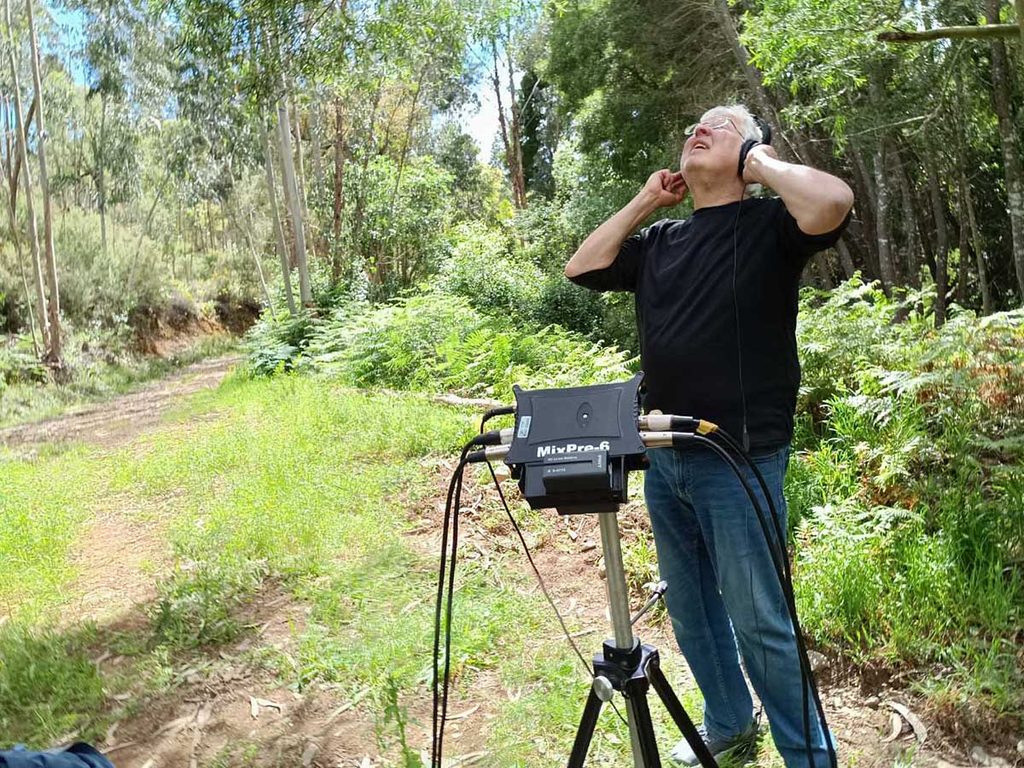
A Sound Devices MixPre-6 portable multitrack outdoor recording system and two Sennheiser MKH 8000 omnidirectional microphones were acquired for the needs of this project to record both the singers and the acoustic environment. Initially, the recordings for this project were made using only these two microphones. As a result, the singers’ voices dominated the recordings, and the natural environment in the background was difficult to hear.
In subsequent recording sessions, an additional recorder and microphones turned away from the singers in order to pick up the echoes. In the studio, these signals were synchronised, balancing the singers and the acoustic environment in which they were singing. Over the course of the project, it became clear that we needed two additional Sennheiser MKH 8000 cardioid microphones to obtain clearer recordings of the echoes without any manmade sounds or mic preamp noise in the background, later these were switched out for a pair of Schoeps CMIT 5 shotgun microphones. Due to the fact that the audio reflections in Latvia are mainly bounced back from tall forests, the level of the signal coming back is comparatively low as compared to the other terrains that offer open faced cliffs and such, so the Sennheisers and Schoeps were ideal microphones to use due to their ultra low noise and high output characteristics. This setup was also utilized during the Portugese sessions as well as the DABĀ festival recordings. My decision to use the wet(ambient)/dry (source signal) microphones allowed me to adjust the balance between the loud Saucējas performance and the ambient sound being reflected back. This allowed more flexibility in setting up recording positions. Of course being further from the source to allow for a more ambient sound resulted in losing definition in nuanced performances. plus there was the obstacles in choosing the physical locations of the recording setup taking into account the local topography.
The acoustic landscape differed in each recording location and session, and over the course of the project we discovered the most optimal placements for the microphones and singers. If the whole group was singing at the same time, the first soloist did not sing directly towards the microphone or stood facing completely away from it in order to balance better with the second soloist and drone singers. Particularly interesting were the sessions in which we made so-called overlapping recordings, involving several groups of singers or individual singers singing at the same time. The placement of microphones was different for each song. We experimented and listened to the acoustics of the environment, how far the singers should stand from each other, and in which direction they should sing. Communications between the performers and engineer was done thru walkie talkie radios.
During the early morning sessions, humidity tended to be higher, and condensation formed on the microphone membranes, which led to technical problems. When recording by lakes, we took advantage of the fact that sound reflects from various points from the other side of the lake, but in marshy areas, a persons would sink into the wet ground, and any movement of the feet would produce loud sucking sounds of pulling something out of the mud. This was a challenge more for myself due to the fact that songs would be over 4 minutes long and I had to restrain myself from any movement in this mire during the performance.
But various naturally occurring sounds, such as the strong rustling of leaves or insects flying too close to a microphone, also created exaggerated noise on recordings that had to be removed because they disturbed the recording of the natural acoustic environment, especially if listening on headphones. At times during the recording sessions, monitoring thru headphones, I would find myself swatting away flies that were nowhere near me:) Proper clothing choices were very important, especially for myself, my leather jacket often made creaking sounds while moving around during the recording process, the same with performers wearing stiffer materials, such as rainwear which also rustled during their movements and gusts of wind. Here and there, however, such sounds were left in the recorded material if the performance of the song was too good to lose.
During the Dabā festival recordings, the recordings were contaminated by audience conversations about who burps the best, sounds of breaking twigs and branches that were trod upon during the performances, footsteps walking along gravel roads, horse flies sounding like WW2 bombers flying past microphones and other unexpected sounds created what may have been a very accurate soundscape of the moment but a less desirable concert recording resulted of these bonus sounds. While other recordists chose to leave these recordings as a historical document, I wanted to experiment with these recordings in an effort to reduce these unwanted noises. I utilized various demixing and noise reduction softwares to split up various components and then remixed the audio signals, removing the unwanted noises. Results worked out fairly well, perhaps not perfect, but a much cleaner recording of the performances in their natural acoustic enviroment was achieved.
Conclusions
While the initial concept and idea of the Echoes of the Ancient project has its merits, especially in connecting various industry professionals from various countries, and a learning curve in the beginning is to be expected, in my opinion a more detailed outline of the various stages and responsibilities to those taking part in the project should have been adopted early on. In my case, I was invited to make quality field recordings of performing artists and share my knowledge of recording methods and later on, give my opinions of the organization of the various events organized. As in any new idea or activity, lessons are to be learned from early mistakes and time and energy wasted on superfluous activities, but with each next step a more focused work method should develop to obtain better results, that would be more interesting to a broader segment of the public. The results I achieved at the DABĀ festival were much better than from the Portuguese sessions, perhaps in part that the interaction of those who had traveled there as tourists, who had nothing to do with the recording process, drew energy away from the project, causing repeated delays and caused stress to those professionals who had come to work in the wild. Of course levity and good spirits is always to be expected when bright people, who share similar interests come together but this professional bonding should not be diluted due to external factors not associated with the project. In my opinion, those involved in the technical and performance ends of the project should not be expected to be involved in the organization of the combined data base. Extra personnel, perhaps even a salaried position to organize the large amount of data that has amassed during the various stages of the project should be hired, in essence, we have done our job, now it should be another professional to compile it all. If mapping of the locations is desirable, then someone with those skills should be invited to do that. If reverb and reflected delay times are to be recorded, those who specialize in these field measurements should be asked to join the project.
I had the creative idea of bouncing recordings of compositions off various rock faces to create a sort of question-answer musical game utilizing the natural acoustics, and I spent a good amount of time creating a recording session in a DAW that was adjustable to the length of the natural bounce back on site. My colleagues from Latvia were ready to “shoot the tune” across the water, but even though equipment for this experiment was promised and available, due to unknown factors these experiments were not performed.
I would also recommend that if in the search for new acoustic studios is to be done in the field, that these searches not be done in haste. At least one hour on each site should be spent, shorter if after initial examinations prove that there is no acoustic space that proves to be interesting.
All in all the Echoes of the Ancient has merit, but perhaps should be divided up into various factions, serious performance recording sessions with examples available online, technical measurements group with frequency responses and reverb times of various acoustic spaces, improvisational experiments within these natural enviroments, and lectures and seminars about these experiments and others that would fall outside the “usual” audio world and perhaps a tourist version to visit these various studios.